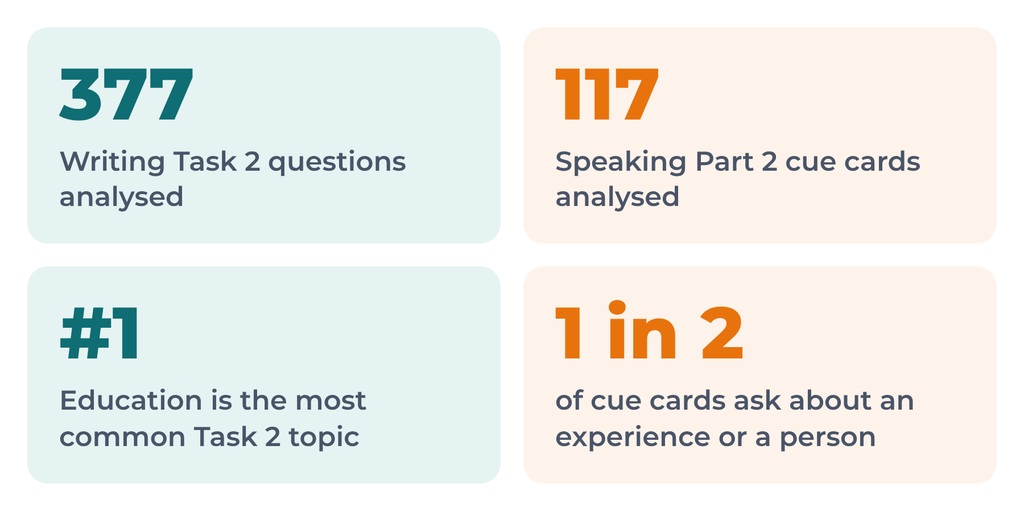
“Which topics will come up in my test?” It’s the question every IELTS learner asks – and IELTS doesn’t publish the answer. So we looked at the evidence. We analysed 494 questions reported by real test takers between 2018 and 2024: 377 Writing Task 2 questions and 117 Speaking Part 2 cue cards.
The results won’t tell you exactly what will be on your test – nobody can do that. But they show clear patterns: which topics come up most often, which questions keep coming back, and how to prepare without trying to learn everything. Here’s a summary. You can download the full guide, with the detailed tables and our method, for free at the bottom of the page.
Writing Task 2: the most common topics
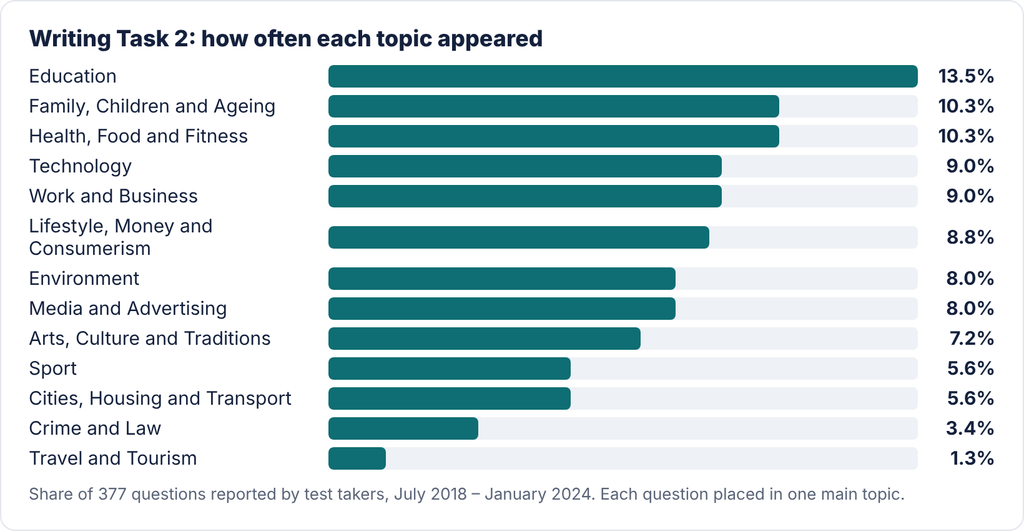
Education was the most common topic, at 13.5% of questions, followed by family and children, health and food, technology and work. But the most important finding is how widely the topics are spread: no single topic made up more than 14% of questions, and it took eight topic areas to cover about three-quarters of them.
What this means for you: there is no shortcut. You can’t prepare two or three topics and hope for the best. But you can prepare smartly – build ideas and vocabulary for the eight biggest areas, and most questions will feel familiar.
Speaking Part 2: what kind of cue card?
For Speaking, the most useful question isn’t which topic but what you have to describe. Half of all cue cards asked about an experience or event or a person.
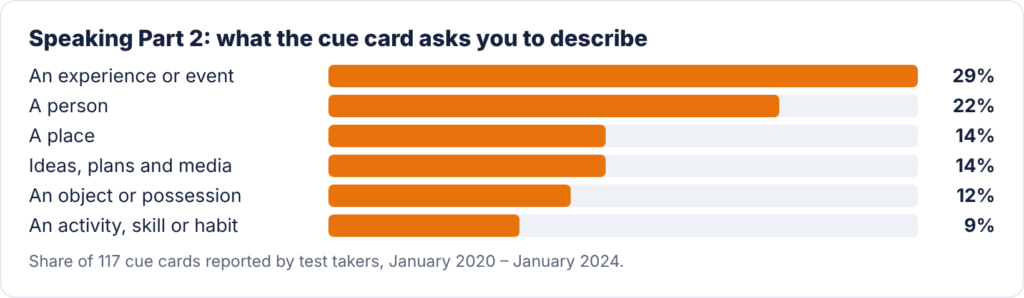
What this means for you: prepare three or four flexible stories – a person, a place, a memorable day and something you own. One good story about a trip with a friend could answer a journey, a friend you’d like to travel with or an outdoor activity in a new place.
Questions that keep coming back
Some themes were reported again and again, in different years:
- Writing: phones and social contact • online or classroom learning • local or imported food • long working hours • banning dangerous sports, reported every year from 2020 to 2024
- Speaking: giving or receiving a gift • an event that changed your life • a special day out that cost little money • a happy event you organised
Many themes, such as gifts, advertising, food, family and technology, appear in both papers – so vocabulary you learn for Writing helps your Speaking too.
Get the full guide
The free 5-page guide includes the full topic tables with typical themes, all the repeat questions, what to expect in Speaking Parts 1 and 3, six ways to prepare, a section for teachers, and a full explanation of our method and sources.
Please note: this is not official IELTS data. The questions were reported from memory by test takers and collected in public archives by IELTS Podcast. The data covers Writing Task 2 and Speaking Part 2 up to early 2024. Sorting questions into topics involves some judgement, and past frequency does not predict your test. We cannot guarantee that any topic will or will not appear.
Sources: IELTS Podcast, Recent IELTS Writing Task 2 questions and Recent IELTS Speaking questions • IELTS, Speaking test format and Writing test format.
All accessed October 2026. Analysis by Kevin Hardwicke, Start IELTS.